
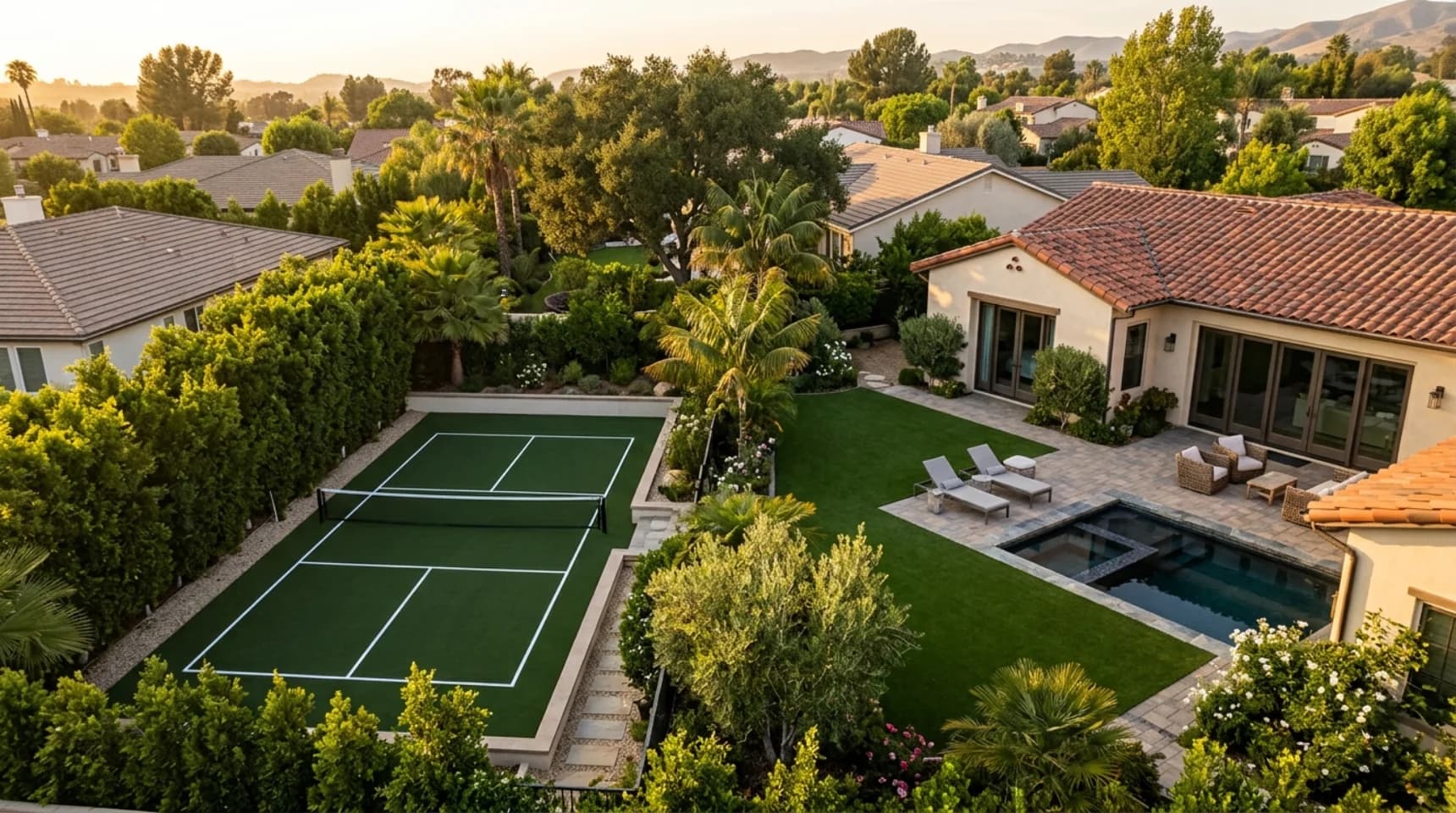

Why Turf, Not Concrete or Asphalt
Traditional pickleball courts use painted concrete or acrylic-coated asphalt. Those surfaces play great but they're brutal on knees and ankles over time, they cook in the sun, and they crack under freeze-thaw. Modern sport-grade artificial turf with a shock pad delivers:
- Consistent ball roll and bounce
- 50% lower impact on joints
- Cool-yarn tech to cut surface temp (see our summer heat post)
- No cracking, no repainting, no resealing
- Playable within hours of a rainstorm — see our drainage guide
Regulation Court Dimensions
A pickleball court is 20 feet wide by 44 feet long — much smaller than a tennis court. Add a minimum 4-foot buffer around the perimeter and you need 28 x 52 feet (~1,456 sq ft) of usable yard.
For the official specs and playing rules, USA Pickleball publishes the current rulebook and court standards.
If you can't fit a full-size court:
- Half court (single kitchen only): 20 x 22 feet, good for skills practice
- Mini court: 15 x 30 feet, works for youth play
Turf Spec for Pickleball
Not any landscape turf will do. Look for:
- Pile height: 3/4" to 1" (short, dense pile for consistent ball roll)
- Face weight: 40–50 oz (heavier feels slower)
- Fiber: monofilament polyethylene with reinforced backing
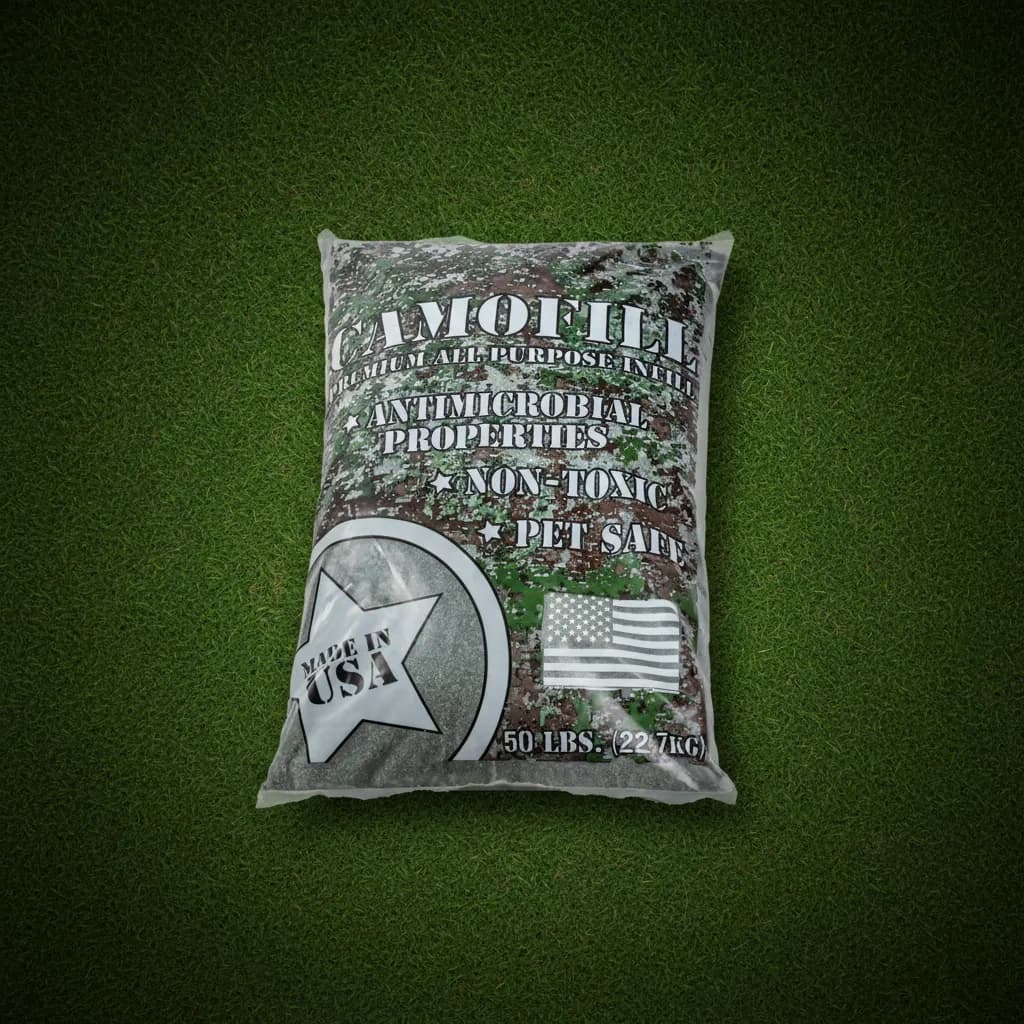
- Infill: silica sand (not rubber) for predictable bounce
- Shock pad: 8–12 mm closed-cell foam beneath, essential for joint protection
- Line marking: inlaid contrast-color turf strips (not painted lines) — they never fade
Our infill guide covers infill selection in detail.
Base Preparation
Sport court bases are unforgiving. Any settlement means uneven bounce.
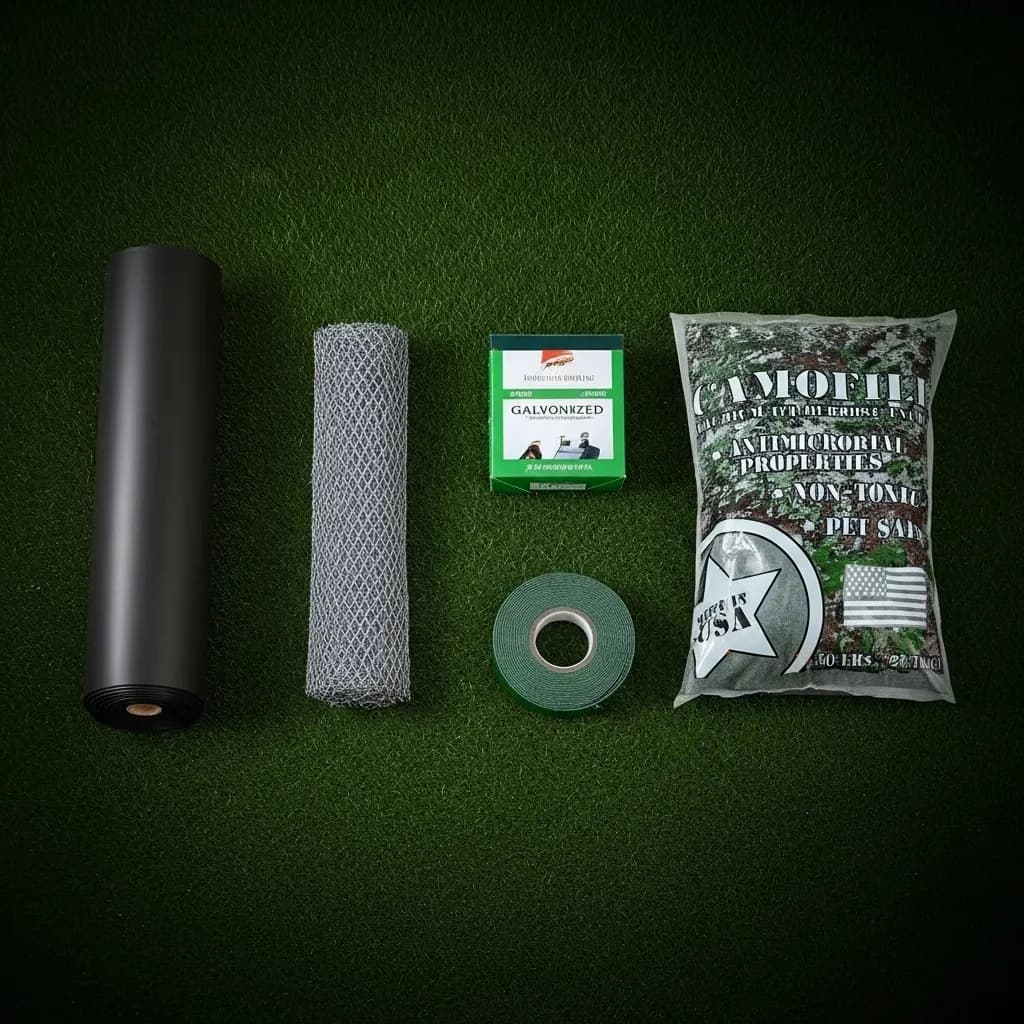
- Excavate 5–6 inches deep across the full court footprint plus perimeter buffer
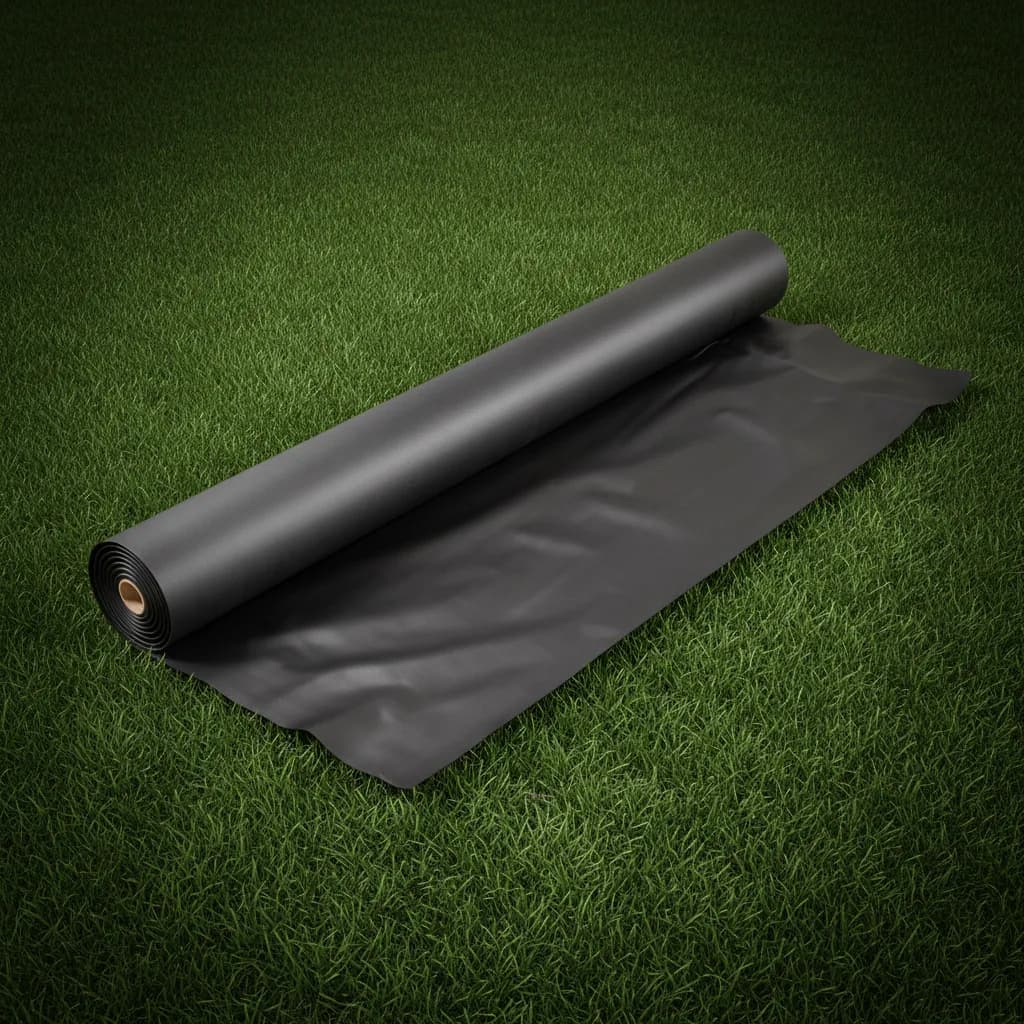
- Install geotextile fabric on native soil
- Add 3 inches of Class II road base compacted to 98%+ density
- Add 1 inch of fine screenings (1/4" minus) as a leveling layer
- Install shock pad panels, tight seams, taped
- Roll and install turf, glue down the perimeter
This is a jobsite where you want a laser level, not just a string line. The tolerance for a sport court is 1/8" over 10 feet — much tighter than residential landscape.
Line Marking
The regulation lines:
- Baselines (back of court, 20 ft wide)
- Sidelines (long sides, 44 ft each)
- Non-volley zone / "kitchen" (7 ft from net on each side)
- Centerline (splits each service court)
- Net centerline (the 34" tall net)
Inlaid white turf strips are the professional approach. DIY: use white pre-marked landscape lines from our supplies inventory.
Fencing and Lighting
Not required but strongly recommended:
- Fencing: 10-foot chain link or premium wood fencing around the full perimeter keeps balls in
- Lighting: 4 low-mounted LED sport-court lights at the corners for evening play
- Windscreens: optional, but reduce ball drift and add privacy
Cost Range
- DIY (materials only): $3,500–5,500 for a full court
- Pro-installed (turf and base): $12,000–18,000
- Turnkey (base, court, fence, lights, net): $25,000–40,000
Financing makes larger builds accessible. For gated communities or club installs, our broker program offers wholesale sport-turf pricing.
Beyond Pickleball
The same sport turf works for:
- Basketball half-court (skinny courts fit in 30 x 30 ft)
- Bocce (with a 60 ft strip)
- Backyard soccer / mini-goal drills
- Multi-sport family zones
For commercial applications — schools, HOAs, hotels — see our commercial turf post.
Ready to Build?
Order sport-turf samples to feel the difference between landscape and sport-grade product. Use the calculator to price the exact court size for your yard. Questions? Reach out via the contact page — we've helped dozens of homeowners spec sport courts.